

The average experience operator uses five or six software tools to run their business. Booking platforms, waiver tools, photo delivery, email marketing, review management. Each one is well-built and solves a real problem. But line them up on a timeline and a pattern emerges: every single one of these tools exists before the experience or after the experience. The during is nearly empty. And it happens to be the highest-engagement moment of the entire guest journey.
The before stack
Before your guest arrives, the tech stack is robust. Booking platforms like FareHarbor, Rezdy, Peek Pro, Xola, Checkfront, and TripWorks handle reservations, payments, calendars, and availability. Waiver tools like Wherewolf collect liability forms and pre-experience data. Channel managers distribute your listings across OTAs. Pricing optimization tools adjust rates based on demand.
These tools are mature, competitive, and well-integrated. They solve real operational problems and most operators would not want to run a business without them. But their job ends the moment the guest shows up. Once the experience starts, the booking platform has done its work. It has no role in what happens next.
The after stack
After the experience ends, a second set of tools takes over. Email marketing platforms like Mailchimp and Klaviyo send follow-up sequences. Review management tools like Podium and Birdeye request ratings. Photo delivery platforms like Fotaflo distribute branded images. Survey tools like Typeform collect feedback.
These tools are also well-built, but they share a timing problem. By the time a follow-up email arrives in a guest's inbox, the emotional peak of the experience has passed. Open rates on post-experience emails sit in the 20-30% range for most operators. Response rates on review requests are even lower. The guest has moved on to their next activity, their next meal, their next city. The engagement window has closed.
Why the during is the most valuable moment
Think about the moment a guest is standing at the third stop of your food experience, having just tasted something incredible. They are grateful. They are engaged. Their phone is already in their hand to take a photo. They feel a genuine connection to the guide standing next to them. This is the single highest-goodwill moment of the entire guest lifecycle.
Now consider what tools are deployed at this moment. For most operators, the answer is zero. The booking platform finished its job two hours ago. The review request email will not arrive until tomorrow. The guest is at peak engagement, and no technology is capturing any of it.
This is not a minor gap. The during is where tips are most natural, where reviews are most authentic, where email capture feels like a fair exchange rather than an ask, and where feedback is most detailed. Every outcome operators chase with after-the-fact tools is easier to achieve in real time.
What happens when you show up during
When a tool is present during the experience itself, the economics of every guest interaction change. Tips get clicked while the guide is standing right there, not hours later when the guest is trying to remember the guide's name. Reviews get written while the experience is still fresh, while the guest can describe the specific moment that made it memorable. Emails get captured before the guest moves on to the next thing on their itinerary. Feedback gets collected before details fade.
None of these outcomes require a hard sell. The guest is already engaged. The guidebook is already open on their phone. The ask is contextual rather than interruptive. A tip button appears on the same screen as the guide's photo and bio. A review link appears after the final stop. An email field appears before the content loads. Each prompt arrives at the moment it makes the most sense.
Digital Guidebooks is the during layer
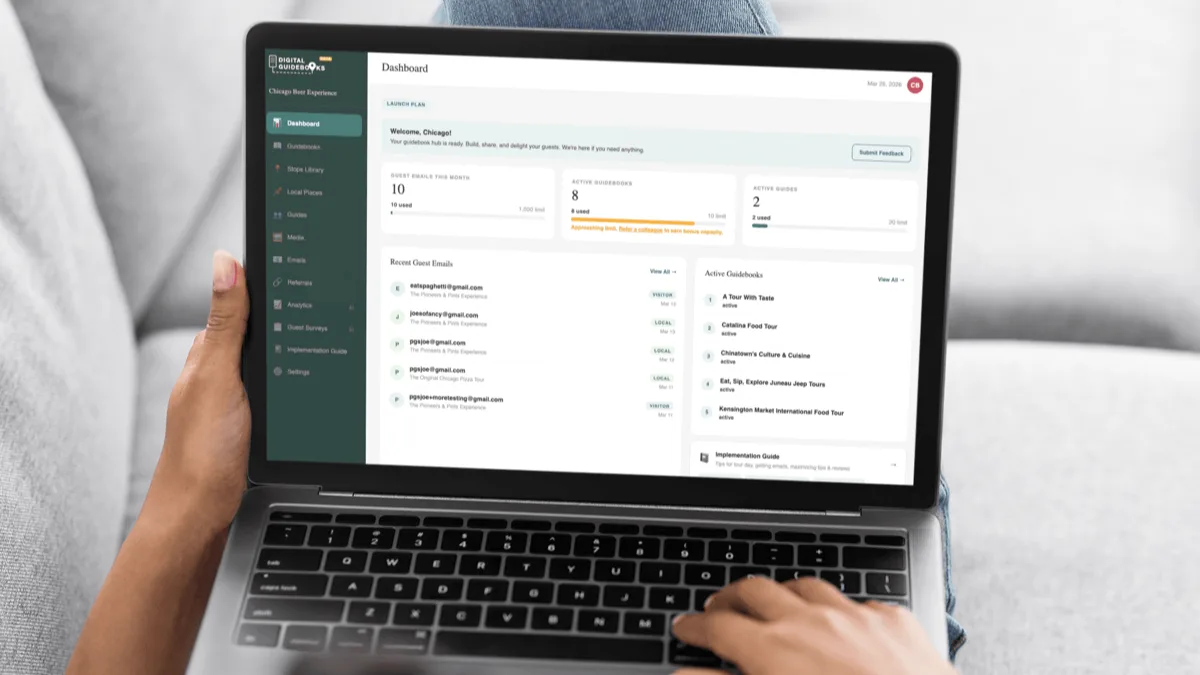
Digital Guidebooks fills the gap between your before stack and your after stack. It is one tool, one link, and it delivers four outcomes: email capture, guide tipping, review collection, and guest feedback. All of it happens while the guest is still on your experience, phone in hand, emotionally engaged.
It does not replace your booking platform, your email marketing tool, or your review management software. It adds a layer that none of those tools cover. Your before stack gets guests to the starting point. Your after stack follows up when the experience is over. Digital Guidebooks is the layer that works while the experience is actually happening.
The result is that your after stack works better, too. When email capture happens during the experience, your post-experience email list is larger and more accurate. When reviews are collected in real time, your review management tool has less heavy lifting to do. When tips happen on the spot, guides are happier without any change to your payroll. One addition to the stack improves everything downstream.
Ready to get started?
Plans start at $99 a month, and every one comes with a 60-day money-back guarantee.
View Pricing →